DealsGamer
Creator — I built the entire front-end application and the IsThereAnyDeal integration, including architecture, the API proxy, UX and deployment.
- Nuxt 3
- Vue 3
- TypeScript
- Tailwind CSS
- Nuxt UI
- Pinia
- Chart.js
Problem
Keeping up with PC game sales means checking several stores one by one. This project brings every deal into one place, with up-to-date data from the IsThereAnyDeal API, without blowing through the API's rate limits.
Solution
A Nuxt 3 app with SSR for better SEO and performance, consuming IsThereAnyDeal through a server-side Nitro proxy — a choice that keeps the API key safe (ITAD_API_KEY never reaches the client) and lets me normalize the data and control request volume. The catalog loads incrementally with auto-load, global search has autocomplete, the game page shows a price table and a visual price history (Chart.js), URLs are slug-based, and favorites/filters are persisted locally with Pinia.
Overview
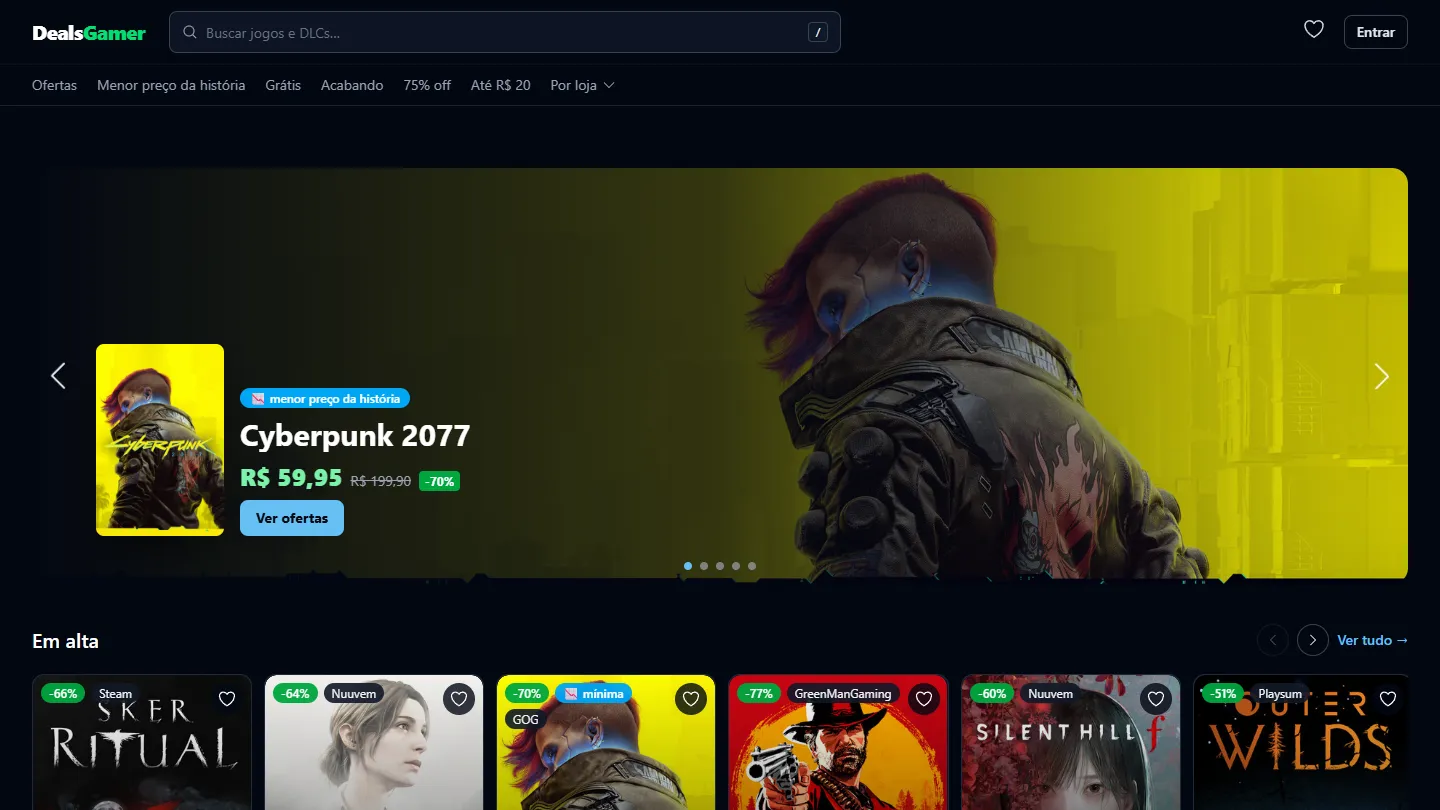
A PC game deal tracker that brings prices and sales from many stores into a single interface, using data from IsThereAnyDeal. The goal is a great user experience while keeping API usage low and predictable.
Features
- Storefront-style home: a hero with Steam artwork and themed shelves.
/ofertascatalog with always-visible filters (a side panel on mobile), applied instantly with state in the URL, plus collections like/ofertas/gratis(free) and/ofertas/acabando(ending soon).- Incremental loading with auto-load plus a manual “Load more” button.
- Global search with suggestions that already show cover art, price, discount and historical low; recent searches and
/andCtrl+Kshortcuts. - Game page with a buy box, stores sorted by price and a visual price history.
- Slug-based URLs (
/game/cyberpunk-2077). - Favorites at
/favoritoswith the current best price, saved in the browser. - SEO: per-page meta, product JSON-LD, canonical URLs, sitemap and robots.
Technical decisions and architecture
- SSR with Nuxt 3: better SEO (key for indexing a catalog) and faster first load.
- Server API routes (Nitro,
server/api/**): the IsThereAnyDeal key lives only on the server, out of the client bundle, and data normalization happens in one place. - SWR caching on the routes: responses are reused across visitors, keeping API usage low and predictable.
- Strict TypeScript throughout, making the integration with external data more reliable.
- Centralized normalization in the
useGamesApi.tscomposable, keeping pages decoupled from the API’s shape. - Global state with Pinia (
stores/games.ts) for favorites and filters, with no server-side storage. - Price chart with Chart.js + vue-chartjs on the game page.
- Yarn 4 with the
node_moduleslinker for faster, reproducible installs.
What I learned
- How to design an API proxy that protects credentials in SSR apps.
- Incremental loading and autocomplete patterns that keep request costs low.
- Continuous deployment on Vercel with environment variables for Production/Preview/Development.